
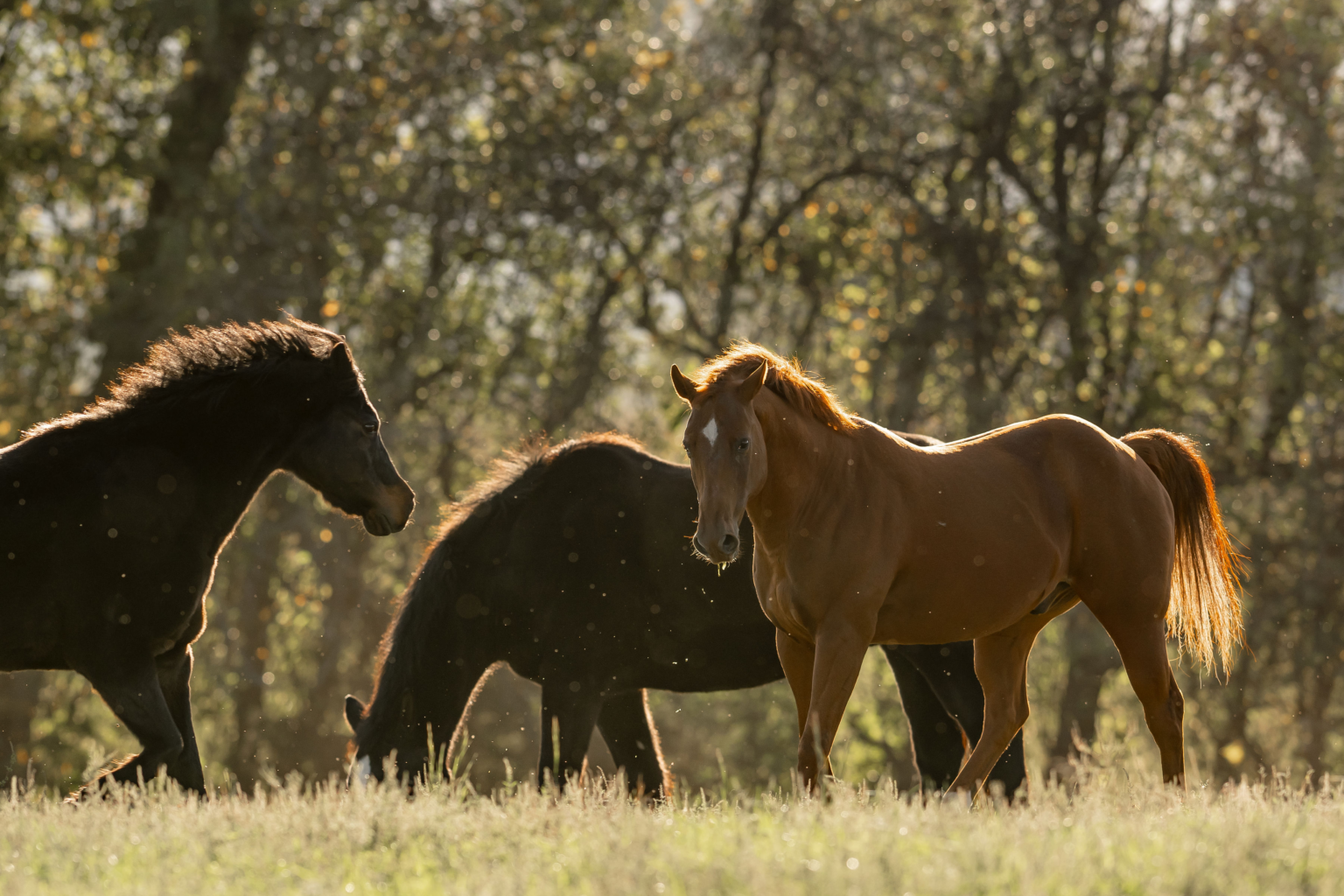
For the last 11+ years, I’ve spent time with horses regularly in my work with Bridle Paths, an equine-assisted services program in Leesburg, Virginia. I was around horses as a kid, but not in the way I am now. Whether working with them in an Equine-Assisted Psychotherapy (EAP) context, riding, or just hanging out, I’ve learned so much from being with our herd.
I love the way horses approach life, and I’ve come to realize there’s an almost one-to-one correlation between how horses live and relate and how we do as humans. Except for belly and ear scratches, much of it is the same. But if belly and ear scratches are your thing, this is a judgment-free zone!
I want to share some of what I’ve learned about life and relationships from horses.
Be in the moment
Horses live in the here and now. Like us, they have stories that impact how they see the world, but for horses, each moment is its own thing. If a horse is eating grass out in the paddock and she hears a loud, unexpected noise, she’s going to react. She might lift her head and perk up her ears, or she might canter off. But as soon as she figures out the noise isn’t a threat, she goes back to eating.
And when she goes back to eating, what she isn’t doing is thinking, “What if that noise happens again? What was it anyway? What if it was a mountain lion, and it’s going to come and eat me?” No, she’s just figuring out which patch of grass she wants to go to next. She goes right back to being present and in the moment.
Sometimes I really want a horse brain! But being around them has made me so much more aware of being present, being right here right now.
Who you are is enough
Horses are inherently honest and authentic. They are who they are and can’t not be that way. And that’s what they want from the humans around them.
When I get to the farm, I know our herd is going to accept me exactly where I am. If I’m grumpy, that’s OK. If I’m sad, that’s OK. And if I’m silly and goofy, that’s OK too. I don’t have anything to prove to them. They don’t have any expectations of me other than to be Beth.
I’m grateful I have humans in my life where I can also show up fully as Beth. That has been one of the greatest gifts of my recovery.
As I’ve watched our horses with each other and with the humans around them, my belief in each of our individual “enoughness” has deepened.
Spend time with people who appreciate you for who you are
Some of our horses were high-level competitors in their sport, and were very successful.
When one horse in particular first came to us, it seemed to be an adjustment for him to know that he received love, care, and support just for who he was, not for his level of performance. And as he’s continued to be loved and appreciated for who he is, he seems more and more free to be himself. He’s more open, he’s silly and playful, he’s more connected to both the horses and the humans.
Think about the people you’re around on a daily basis — at work, at home, with friends. Are there places where you genuinely feel loved and appreciated for who you are, rather than what you do?
Be honest with yourself about what you’re feeling
In childhood, many of us learned that we had to hide what was really going on inside of us. We may have been in pain or afraid, but no one would know it based on what they saw on the outside. That ability was a survival mechanism we needed at the time.
But as adults on a healing journey, we start to learn that in safe relationships, we can be more congruent and let our inner experience be seen by others.
An interesting thing about horses is that they feel safest with humans when we’re congruent. Because horses are prey animals, they move through life the way deer and rabbits do — highly attuned to what’s happening around them. So if something happening on the inside of a person doesn’t match what’s happening on the outside, it can be unsettling.
We’ve had clients in EAP sessions express deep, loud anger, and the horse walks right up to them. And I’ve been in sessions where a client is feeling big emotions but isn’t showing it, and the horses move around the arena in an unsettled way.
Being connected and congruent invites safety and connection for horses. And for humans.
Live in community
We live in a culture that seems to prize independence and individualism. There’s value in each, but often they’re sought after at the exclusion of community and connection.
Horses are herd animals. They live in community. Their herd provides safety and companionship. They care for each other, look out for each other, and each has a place in the herd. And no place is better than another — every horse is important to the herd.
In our herd, we have an eleven-year-old turned out with two horses who are twenty-five and twenty-seven, and we joke that the older two are teaching him how to be a productive member of society! The younger guy is learning about community and relationships from the older two.
I think about this a lot in terms of healing and recovery. Many of us had to live with a fierce independence born out of our experiences in our family of origin. We experienced relational woundings that need a context of relationship for healing.
Like horses, our community can provide us with safety and connection. Horses will not thrive if they are alone. And neither will we.
Boundaries are important for relationships
Horses are great at boundaries. They’re clear with each other and with the humans around them about what they need.
They don’t wonder if their boundaries are OK, and they don’t take offense at each other’s boundaries, or the boundaries that humans need. Boundaries provide clarity, and clarity fosters connection, because everyone knows where everyone else stands.
One of our horses, Chance, has a bigger space bubble than some of the others. As we like to say, physical touch is not his love language. When I first met him, connecting with a horse usually meant figuring out where he liked to be scratched. But with Chance, I realized space was the first step in getting to know him. So I’d just hang out near him without putting my hands on him. Connection and trust built from there. And he still has a big space bubble. Sometimes he wants to be in close proximity and sometimes he doesn’t. Both are OK. And we stay connected either way.
It’s the same with humans. When our boundaries are respected, we feel safe, cared for, like we matter. And that’s foundational to building trust and connection.
Ask for what you need
One of the coolest things I’ve seen and experienced with horses is that they ask for what they need, and they don’t wonder if it’s OK. There’s none of this: “If I ask for my ears to be scratched, I better make sure to do something nice back.” Or, “I want to eat my hay and not interact with Beth, but what if she gets mad?”
The mental shenanigans that go on in human brains don’t happen with horses. They feel free to ask for what they need, and it’s OK with them if someone says no. If a horse approaches me during a session with a client and wants his bum scratched, I might say no to him in that moment. He doesn’t get offended. He may ask a few more times, but he’s not offended each time I say no.
And later in the day, the no from earlier won’t keep him from asking again. They can always ask — whether it’s with a human or each other.
There have been countless times in sessions when clients have had an aha moment about relationships as they’ve connected with our herd. Sometimes it’s watching the horses interact with each other — “That horse is so nurturing with the others, and they can receive it from her. That’s something I need to work on.” Sometimes it’s noticing how they themselves are interacting with a horse — “Oh my gosh, my energy is getting intense as I’m trying to get this horse to interact with me. This is just what I do with my partner.”
These are just a few of the lessons our herd keeps teaching me. Be curious about any of them that resonated with you. That might be a starting point for another place of healing for you.
Want to learn what our herd might teach you? Working with them is part of my individual intensives. Learn more.
Photo credit: Erin Gilmore Photography (And yes, those are members of our herd: Pumpkin, Admiral and Sunup!)