
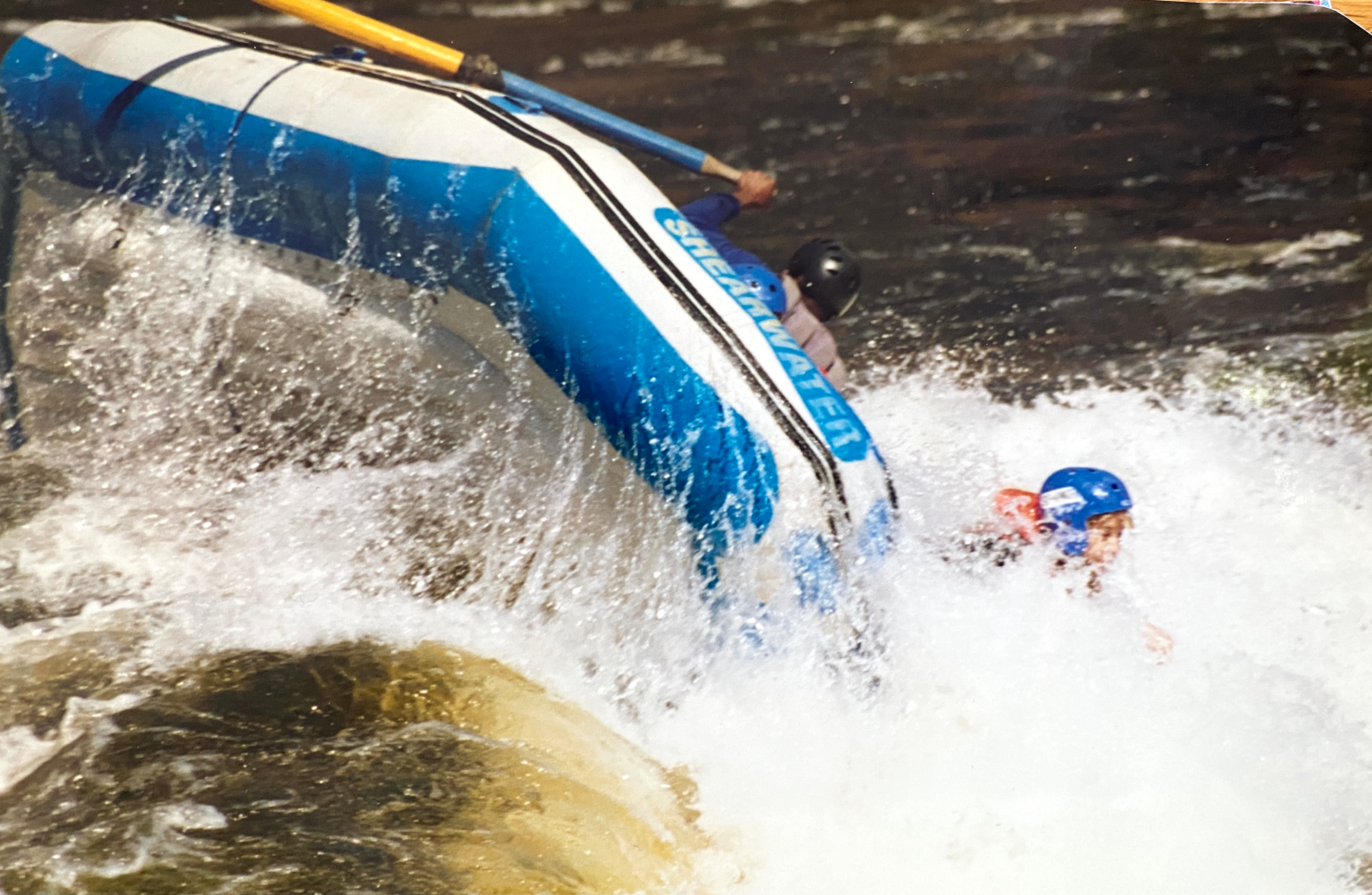
In 1998, I had the opportunity to travel to Zimbabwe. As part of my trip, I spent some time at Victoria Falls (there’s a reason it’s listed as a natural wonder of the world!) and went whitewater rafting on the Zambezi River.
In preparation for our trip, the guides went over the safety instructions, which included what to do if you got sucked into a whirlpool. I went rafting following the rainy season, when the water was high, which can create whirlpools. The alternative is going when the water is low, and the danger is crocodiles. I’ll take the whirlpools.
The guides told us that if we got sucked into a whirlpool, we were to ball up and relax until the whirlpool was done with us and spit us out. We all practiced putting ourselves into a little ball, and off we went.
At about the third or fourth rapid of the day, our raft flipped. I ended up stuck underneath the boat in the racing, over-my-head water. I got myself out from under the boat and held on to the safety line. Then suddenly I wasn’t holding onto it anymore. The whirlpools are real, people. That ball up and relax business went right out the window. My instinct wasn’t to relax; it was to swim to the surface! So I tried. And tried. And tried. The only thing all of that trying did for me was to make me exhausted.
Obviously, the whirlpool spit me out because you’re reading this today. But man, was I exhausted afterward, and I had 22 rapids to go! If I had done what the guides told me, I wouldn’t have used up so much energy or experienced as much panic. But relaxing felt counterintuitive. And that’s often what acceptance feels like, too.
If you’re on a healing journey of any kind – childhood trauma healing, addiction recovery or any number of circumstances, you’ve likely heard about acceptance. I talk to my clients about it a lot, and I find that it’s often met with some resistance. The resistance is usually a combination of confusion, anger, and fear.
There is confusion because at first glance, it doesn’t appear to make sense. Accept the thing that’s making your life miserable? What do you mean I have to have acceptance for my struggle with shame? I should just sit around and feel like crap? I don’t want to accept it, I want it to STOP.
There’s anger because it’s usually not what people want to hear. They want to get away from what’s happening, not accept its existence. And there’s fear because they don’t know any other way, and the unknown can be scary. What if I feel something worse than I’m already feeling?
When we’re in a difficult situation, we tend to worry, judge, or work hard to figure it out. We put a lot of mental and emotional energy into the fact that x is happening or that we still struggle with y (I can’t believe this is happening again. Why does this keep happening to me? What’s wrong with me?). Or we avoid what’s happening through denial or shutting down. Both responses are ways of trying to navigate the experience with whatever survival responses we have available to us. They make sense. They’re just no longer what we need.
Unfortunately, none of these options actually allow for change or healing. They keep you stuck in a loop. Rather than moving through a difficult situation, you’re more likely to stay stuck in it—even after the situation is over.
Avoidance and judgment don’t allow space to connect with your experience of the difficulty (which makes sense, because the experience is uncomfortable). Fighting, avoiding, or judging our struggles rather than accepting them uses a lot of energy unnecessarily and creates a great deal of anxiety, just like me on that rafting trip.
The practice of acceptance can create a path to experiencing tough situations differently. I’m not talking about resignation.
Acceptance isn’t about giving up or giving in. Acceptance isn’t saying that you’re glad the painful thing is happening. Acceptance is giving up fighting against your reality. It’s settling into the fact that you have a particular struggle and that it’s real for you. And then allowing yourself to be with that experience.
Here’s what that actually looks like in practice. Let’s say you’re working on shame that you carry from childhood experiences. You’ve been working on it awhile and feel like you’re noticing improvements. Then the shame gets triggered again.
Avoidance, judgment, and worry look like:
- Getting reactive when your shame gets triggered
- Getting angry at yourself that it’s happening
- Having anxiety about the fact that the shame is there
- Wishing it would just go away.
Acceptance looks like:
- Noticing it without judgment
- Seeing if you can identify what triggered it
- Having compassion that this is a real struggle for you
- Using the tools that you’ve learned to take care of yourself
Or, you’re in a quiet part of your day and you realize you feel deep sadness and you don’t know why. And you’re uncomfortable with what’s coming up…
Avoidance, judgment and worry look like:
- Trying really hard to figure out why you’re sad
- Thinking you have no reason to be sad because your life is good
- Telling yourself you have better things to do than sit and be sad
- Deciding it doesn’t help to feel sad
Acceptance looks like:
- Approaching the sadness with curiosity
- Taking a breath and giving your body room to move the emotion through
- Reaching out to a trusted person in your life
- Taking a minute to pause and allow it to just be.
The practice of acceptance isn’t easy. It’s not something that comes naturally to most of us. When we feel threatened or scared or confused, our instinct is to survive—figure it out, avoid it, deny it. My instinct in that whirlpool was NOT to ball up and relax! If you struggle with practicing acceptance in difficult situations, that only means you’re having a human experience. It doesn’t mean you’re doing anything wrong.
Eventually, the whirlpool spit me out — not because I figured out how to fight it, but because that’s what whirlpools do. And when I surfaced, there was a guide in a kayak right there. He’d been alongside me the whole time. I had no idea. He pulled me up.
That’s what healing looks like sometimes. You stop exhausting yourself fighting what’s happening, you surface, and you turn toward support that may be closer than you realized.
If you’re in that place right now — worn out from fighting and ready to try something different — I’d love to help you navigate possible next steps. I offer 60-minute consultations – a focused time to help you get the insights and direction you need to keep making progress in your recovery.
Photo credit: The person from Shearwater Adventures who took this photo. Yes, that’s my boat that flipped!